The Pull Without Words: Why Your Why Doesn’t Need to Be Articulate to Be Real


I know exactly what I’m building.
A coaching practice. An approach to understanding how toxic environments colonize your capacity. Eventually, a psychology career where I can help people rebuild what gets broken in pl.
I even know HOW to get there: weekly Substack, grad school applications when the time is right.
But if you asked me WHY—really why, at the deepest level—I’d fumble.
I’d gesture at concepts: helping people, understanding the psyche, escaping a toxic job that turned my competence into a question mark. I could give you the elevator pitch version, the one that sounds good at dinner parties. But none of that feels like the REAL why.
The real why is something I feel in my chest when I write these pieces. Something that pulls me forward even when I’m tired. Something that makes this feel inevitable even though I can’t defend it logically to someone who asks “but why THIS instead of something easier?”
And for a long time, that bothered me.
Until I realized: maybe the inarticulate pull is more trustworthy than the polished explanation.
The Tyranny of Articulable Whys
We live in a culture that worships clarity.
Simon Sinek told us to “Start With Why,” and he’s not wrong—but it created an unintended pressure. Now we’re supposed to have our why polished, quotable, ready to defend at job interviews, grant applications, and family dinners where someone inevitably asks: “So... why are you doing this again?”
The subtle message underneath: If you can’t articulate it perfectly, maybe it’s not real. Maybe you haven’t thought it through. Maybe you should wait until you have better answers.
This creates a specific kind of paralysis. People wait for their why to crystallize before they take action. They think clarity comes first, then movement. They’re waiting for the moment when they can confidently explain themselves to skeptics—internal or external.
But here’s what I’ve learned: there are two kinds of why.
The Marketing Why: What you tell other people. The polished version. The one that makes sense to someone evaluating your choices from the outside.
The Felt Why: What actually moves you. The inarticulate pull. The thing your nervous system knows before your brain can explain it.
Most advice assumes these are the same thing, or that the second one should become the first one as quickly as possible.
I’m not convinced that’s true anymore.
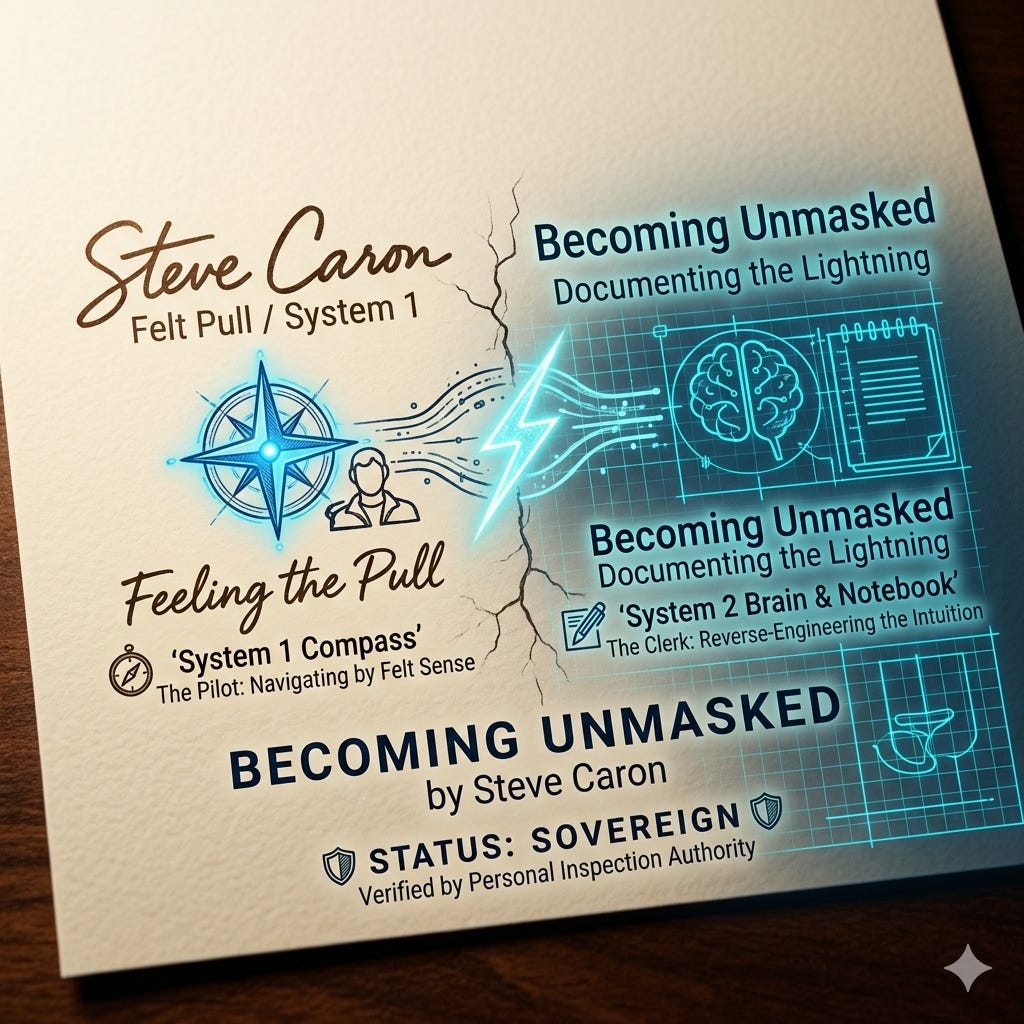
System 1 Knows Before System 2 Can Explain
In Daniel Kahneman’s “Thinking, Fast and Slow,” he describes two systems of thought:
System 1 operates below language. It’s fast, automatic, intuitive—the processes that integrate massive amounts of data you can’t consciously access. It generates felt sense, gut certainty, direction. It tells you “this matters” or “this is wrong” without needing to file a report about why.
System 2 is your conscious, verbal, analytical mind. It’s slow, deliberate, logical. It tries to reverse-engineer what System 1 already knows. It creates narratives, explanations, justifications. It’s useful for communicating to others, for planning, for defending your choices in a world that demands reasons.
But System 2 is NOT the source of the pull itself.
When you feel drawn to something—a career change, a creative project, a relationship, a way of being in the world—that’s System 1 operating. It’s already integrated information you don’t have conscious access to: your values, your past experiences, your nervous system’s read on what environments allow you to function versus which ones drain you to zero.
Your System 1 already knows your why.
Your System 2 is just struggling to translate it into words that will satisfy the people (including yourself) who keep asking “but WHY?”
The insight: The pull is real even if the words aren’t there yet.
The inarticulate certainty isn’t a bug waiting to be fixed. It’s not incomplete knowing that needs to become complete. It’s a different kind of knowing—one that doesn’t require articulation to be legitimate.
The Inarticulate Pull as Signal, Not Noise
Let me flip the script for a minute.
What if the inarticulate pull is actually MORE trustworthy than the polished explanation?
Think about the people you know who can perfectly articulate their why. Some of them sound genuine—you can feel the alignment between their words and their energy. But some of them sound... rehearsed. Like they’ve talked themselves into something. Like they’ve built a beautiful narrative that they’re now performing, even to themselves.
The things that matter most—love, beauty, meaning, calling—resist perfect articulation.
Ask someone why they love their partner, and if they give you a bullet-pointed list of qualities, you might actually worry about them. The real answer is something closer to “I don’t know, I just do.” Ask an artist why they make what they make, and the honest ones will say some version of “I had to. I can’t explain it better than that.”
Your nervous system knows things your conscious mind hasn’t caught up to yet.
It knows which environments are contaminated and which are clean. It knows which activities restore your capacity and which ones drain it. It knows what feels like building versus what feels like performing. It knows when you’re in your realm versus someone else’s.
And sometimes, it knows you need to do something before it can tell you why.
The question becomes: Would you rather have a polished why that you’re performing, or a messy pull that’s actually moving you?
Working With the Pull: The Tool
If you can’t—or won’t—articulate your why yet, that doesn’t mean you’re directionless. It means you’re working with different data.
Here’s a practical exercise I’ve been using. Instead of forcing articulation, map the felt sense.
The Pull Inventory
1. When does the pull intensify?
Don’t ask “why am I doing this.” Ask “when does this feel most necessary?”
For me: when I’m writing these pieces. When I’m thinking about how toxic environments colonize capacity. When I think about coaching someone through the exact territory contamination I experienced. When I imagine having a practice where I can help people map their own geography of capacity.
Those moments of intensification are data. Your System 1 is telling you “warmer, warmer, warmer.”
2. What does the pull feel AWAY from?
Sometimes the why is clearer in its negative form. Sometimes you know what you’re leaving more clearly than what you’re moving toward.
I’m being pulled away from: toxic judgment masquerading as management. Capacity loss in contaminated realms. Being someone else’s failed project. Performing competence while feeling like a fraud. Accepting someone else’s verdict as truth about my worth.
The opposite of that might be closer to my why than any positive articulation. Maybe my why is simply: “Because I refuse to accept that version of the story anymore.”
That’s not polished. But it’s true.
3. What metaphors or images come up?
Not logical explanations—resonant images.
When I think about this work, I see: building on clean ground. Accurate mirrors. Reinstalling my own operating system. Withdrawing from contaminated territory and choosing my own inspection authority.
These aren’t explanations. They’re closer to poetry than to logic. But they might be closer to my why than any elevator pitch I could construct.
4. Who shows up when you imagine success?
When you picture yourself doing this work well, who benefits?
For me: I see someone six months into working with a toxic manager, paralyzed by emails, doubting their own competence despite clear evidence. I see them discovering they’re not broken—they’re just operating in a poisoned realm. I see them making the withdrawal choice before it destroys them.
That person might be my why. Or at least, one version of it.
The Practice
Trust the pull first. Let articulation come later.
Build while System 2 catches up to what System 1 already knows.
Your why doesn’t need to be defendable to be real. It doesn’t need to make sense to anyone but you. It doesn’t need to fit on a vision board or sound good in a LinkedIn post.
It just needs to move you.
Permission to Move Without Perfect Clarity
Here’s what I’m learning to accept:
You don’t need to defend your why to start building.
Not every meaningful thing can be reduced to an elevator pitch. Some of the most important work gets done by people who couldn’t fully explain why they were doing it until they’d already done it.
Sometimes you have to build first and discover the why through the building itself.
The why reveals itself through engagement, not through thinking harder about it in the abstract.
I’m building this coaching practice on a pull I can’t fully articulate yet. And I’m learning to trust that the pull knows something I don’t. Maybe six months from now, I’ll write the follow-up piece: “I Found My Why.” Maybe I’ll have language for what’s moving me.
Or maybe I’ll write: “The Pull Was Always Enough.”
Either way, I’m not waiting for perfect clarity to start moving. I’m not going to let the tyranny of articulable whys keep me in a contaminated realm while I wait for better answers to hypothetical questions.
The pull is the permission slip.
System 1 is already leading. System 2 will catch up when it’s ready.
If You’re Here
If you’ve been waiting for your why to crystallize before you take action, read this slowly:
The pull is real even if you can’t name it yet.
Your System 1 is already giving you direction. It’s integrating data you don’t have conscious access to. It’s telling you what matters, what’s necessary, what needs to happen next.
Your System 2 will catch up. The words will come. The articulation will arrive when it needs to.
But waiting for perfect clarity is just another way to not start.
Trust the pull. Build on it. Let the explanations come later.
Sometimes the most honest answer to “Why are you doing this?” is simply:
“Because I have to. And I’ll tell you why once I understand it myself.”
That’s not weakness. That’s not lack of clarity.
That’s System 1 leading the way, and System 2 having the humility to follow without demanding a full briefing first.
Your inarticulate pull might be the most trustworthy thing about your direction.
Stay grounded—and trust what moves you, even when you can’t name it.