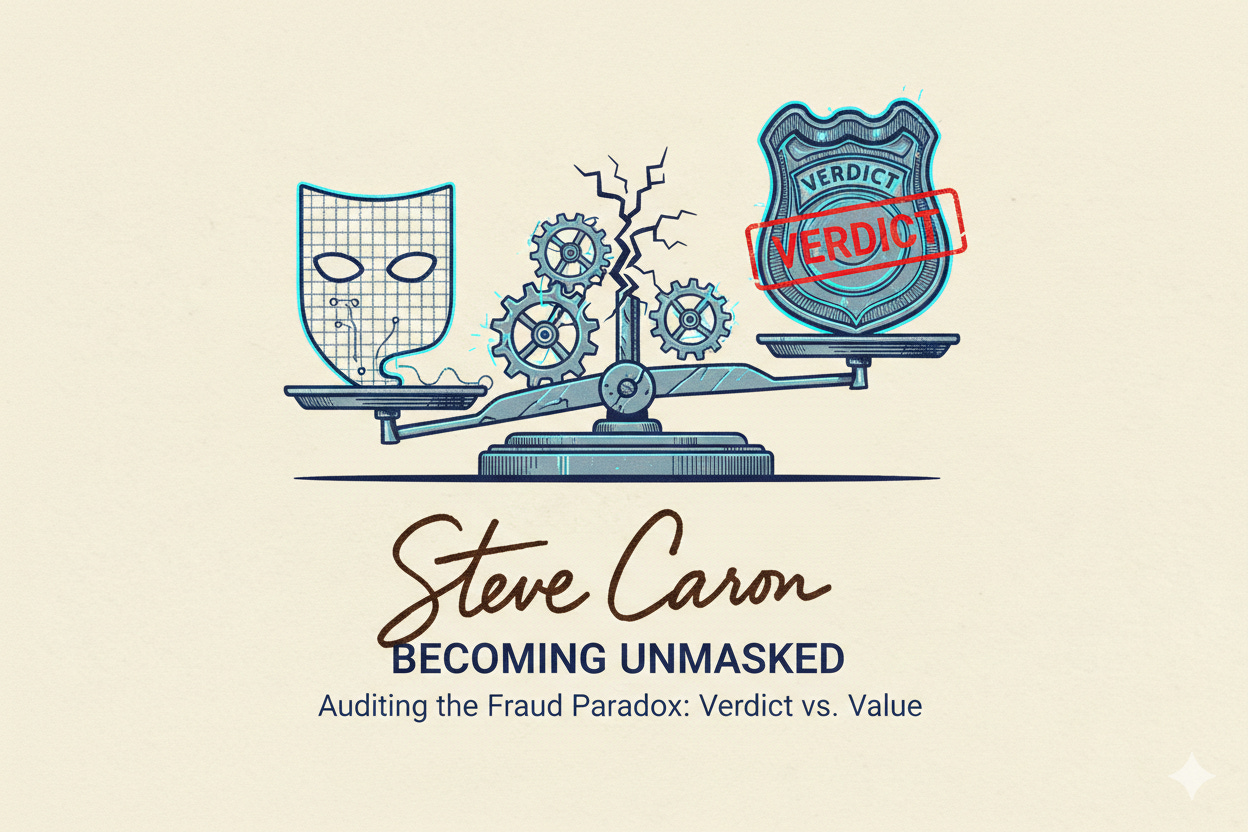
The Verdict vs. The Value
Auditing the Fraud Paradox


I can ace an exam in the top percentile, wire a house with surgical precision, and install I-joists in a duplex without breaking a sweat. My hands know exactly what to do. My brain solves the math before the question is finished.
And yet—a single notification from a work can drop me to zero. I’ll stare at a simple email for three days like it’s written in an ancient, cursed language. I’ll wander aimlessly through my house because a phone ringing just flushed my working memory.
So which one is “Steve”? The top performer or the one paralyzed by a ringtone?
The answer is: Both. And if you’ve ever felt like a fraud despite clear evidence of your competence, you already know this split intimately.
One Insight — The Realm Where Capacity Goes to Die
I used to think ability automatically minted confidence. I was wrong. But I was also wrong about what happens when that confidence gets attacked.
Here’s what actually happens: when an authority figure—a toxic manager, a biased superior, a “judge” with a badge—stamps “Not Good Enough” on your file, they don’t just crack your foundation. They turn their entire sphere of influence into hostile territory.
It’s not that your capacity remains intact while your confidence crumbles. It’s that their realm becomes a place where you can’t access your capacity at all.
The same brain that calculates wire loads for fun completely flatlines when it sees his name in an email subject line. The same hands that install I-joists with surgical precision freeze when they’re working on anything adjacent to his domain. It doesn’t matter if he’s physically present or on another continent—just knowing you’re operating in his realm of influence triggers a complete shutdown.
This is what makes the fraud feeling so insidious. You know you have the ability because you’ve proven it a thousand times in neutral territory. But in his realm, that ability becomes completely inaccessible. So you start to question: which version is real?
Both are real. You’re not a fraud. You’re under siege.
One Real Moment — The Territory Trap
Here’s the paradox that makes me want to laugh and crawl under my drafting table at the same time: the performance is real, and the paralysis is also real. But the paralysis isn’t proof of fraud—it’s proof that his verdict poisoned the entire territory.
I didn’t get the opportunity to fail gradually and learn from it. I got labeled as a failure by a “judge,” and my nervous system marked his entire domain as a threat zone. Not because I’m actually incompetent there, but because authority judgments don’t just evaluate performance—they colonize context.
The metaphor that finally clicked for me: I’m built with solid materials—quality components, good bones. But someone stamped the inspection report wrong, and now every job site connected to that inspector becomes contaminated. The structure didn’t weaken; the territory became hostile.
And operating under siege consumes all available resources. You can’t access your capacity because your entire system is allocated to threat detection. The abilities exist—they’re just held hostage by the context.
I’m a Samsung guy in a world that tried to force me to run a glitchy, proprietary operating system. The phone works perfectly on other networks. But on his network? Complete system failure. The problem isn’t the device—it’s that his infrastructure is incompatible with my actual hardware.
One Tool — The Data vs. Interpretation Audit
Interpretations are not sacred just because they wear a badge or a title. To stop false verdicts from contaminating entire territories of your life, you need to perform a cold-blooded audit of the “evidence” used against you.
The Strategy: Keep the data—but recognize it’s context-specific. Your performance in a poisoned realm doesn’t predict your performance in neutral territory. Challenge the verdict—it’s an attempt to make his local judgment into a universal truth about your worth.
The fraud is the verdict claiming jurisdiction beyond its actual domain.
Here’s what changes everything: you’re not broken everywhere. You’re inaccessible in specific territories that have been marked as hostile. The work isn’t fixing yourself—it’s recognizing which territories are contaminated and withdrawing your operations.
Important Addendum: Sometimes your internal instruments are so compromised by operating under siege that logic alone won’t cut it. When you’re in survival mode, seek “external scaffolding”—a mentor, a therapist, or a friend who can see your capacity in neutral territory and mirror it back when you’ve lost sight of it. They can confirm: the abilities still exist. The realm is the problem.
One Micro-Win — The Territory Test
My win this week wasn’t a grade or a score. It was recognizing that my capacity hasn’t disappeared—it’s geography-locked.
Outside his realm: I function. Inside his realm: I flatline. Same person, same brain, same hands. Different territory, completely different access.
I don’t need a new brain. I need to stop accepting one person’s contaminated territory as evidence of my worth across all domains. Capacity returns through operating in clean territory, not through trying to decontaminate poisoned ground while still standing on it.
If You’re Here
If you feel like a fraud because your capacity varies wildly by context, read this slowly:
**Fraud is pretending to have an ability you don’t have.**
You are doing the exact opposite. You have the ability—it’s proven in neutral territory. But someone’s verdict turned a specific domain into hostile terrain where that ability becomes inaccessible.
That’s not deception. That’s what happens when you try to operate under siege. And the solution isn’t resilience or pushing through. It’s recognizing that some territories are poisoned, and the only way to reclaim your capacity is to withdraw from the contaminated ground.
You’re not broken everywhere. His realm is broken for you. And there’s a difference between structural failure and territorial incompatibility.
The work now is mapping which territories are actually yours, which are poisoned, and where you can rebuild without carrying his verdict into clean spaces.
Sometimes with your own tools. Sometimes with someone else holding the flashlight. But always on ground you choose for yourself.
Stay grounded—and keep your own inspection authority.